
Designing a Customer Value - Driven Marketing Strategy and Plan
MKT101: Principles Of Marketing CHAP 1: CREATING CUSTOMER VALUE AND ENGAGEMENT
4. Designing a Customer Value - Driven Marketing Strategy and Plan
a. Customer Value- Driven Marketing Strategy
-
Marketing management as the art and science of choosing target
markets and building profitable relationships with them. The marketing manager’s aim is to engage, keep, and grow target
customers by creating, delivering, and communicating superior customer
value. To design a winning marketing strategy, the marketing manager
must answer two important questions: What customers will we serve
(what’s our target market)? and How can we serve these customers best
(what’s our value proposition)?
- Select Customer To Serve:
- The company must first decide whom it will serve. It does this by dividing the market into segments of customers (market segmentation) and selecting which segments it will go after (target marketing)
- Choosing a Value Proposition:
- The company must also decide how it will serve targeted customers—how it will differentiate and position itself in the marketplace. A brand’s value proposition is the set of benefits or values it promises to deliver to consumers to satisfy their needs
- Marketing Orientation:
- Marketing management wants to design strategies that will engage target customers and build profitable relationships with them. But what philosophy should guide these marketing strategies? What weight should be given to the interests of customers, the organization, and society? Very often, these interests conflict There are five alternative concepts under which organizations design and carry out their marketing strategies: the production, product, selling, marketing, and societal marketing concepts
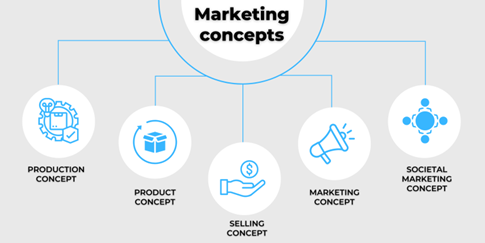
- + Production concept: The idea that consumers will favor products that are available and highly affordable; therefore, the organization should focus on improving production and distribution efficiency
- + Product concept:
- The idea that consumers will favor products that offer the most quality, performance, and features; therefore, the organization should devote its energy to making continuous product improvements.
- + Selling concept: The idea that consumers will not buy enough of the firm’s products unless the firm undertakes a large-scale selling and promotion effort
- + Marketing concept: A philosophy in which achieving organizational goals depends on knowing the needs and wants of target markets and delivering the desired satisfactions better than competitors do
- + Societal marketing concept: The idea that a company’s marketing decisions should consider consumers’ wants, the company’s requirements, consumers’ lon