How People Interact
ECO111: Principles Of Economics Chap 1: Ten Principles Of Economics
2. How People Interact:
-
Principle 5: Trade Can Make Everyone Better Off
- People benefit from trade:
- - People can buy a greater variety of goods and services at lower cost.
- Countries benefit from trade:
- - Allows countries to specialize in what they do best
- - Enjoy a greater variety of goods and services
You may have heard on the news that the Chinese are our competitors in the world economy. In some ways, this is true because American and Chinese firms produce many of the same goods. Companies in the United States and China compete for the same customers in the markets for clothing, toys, solar panels, automobile tires, and many other items. Yet it is easy to be misled when thinking about competition among countries. Trade between the United States and China is not like a sports contest in which one side wins and the other side loses. In fact, the opposite is true: Trade between two countries can make each country better off.
Principle 6: Markets Are Usually a Good Way to Organize Economic Activity
Most countries that once had centrally planned economies have abandoned the system and are instead developing market economies. In a market economy, the decisions of a central planner are replaced by the decisions of millions of firms and households. Firms decide whom to hire and what to make. Households decide which firms to work for and what to buy with their incomes. These firms and households interact in the marketplace, where prices and self-interest guide their decisions.
Economist Adam Smith made the most famous observation in all of economics: Households and firms interacting in markets act as if they are guided by an “invisible hand” that leads them to desirable market outcomes.
When a government prevents prices from adjusting naturally to supply and demand, it impedes the invisible hand’s ability to coordinate the decisions of the households and firms that make up an economy.

Principle 7: Governments Can Sometimes Improve Market Outcomes:
One reason we need a government is that the invisible hand can work its magic only if the government enforces the rules and maintains the institutions that are key to a market economy. Most importantly, market economies need institutions to enforce property rights so individuals can own and control scarce resources.
Another reason we need a government is that, although the invisible hand is powerful, it is not omnipotent. There are two broad rationales for a government to intervene in the economy and change the allocation of resources that people would choose on their own: to promote efficiency or to promote equality. That is, most policies aim either to enlarge the economic pie or to change how the pie is divided.

To say that the government can improve on market outcomes does not mean that it always will. Public policy is made not by angels but by a political process that is far from perfect. Sometimes policies are designed simply to reward the politically powerful. Sometimes they are made by well-intentioned leaders who are not fully informed. As you study economics, you will become a better judge of when a government policy is justifiable because it promotes efficiency or equality and when it is not.
3. How the Economy as a Whole Works
Principle 8: A Country’s Standard of Living Depends on Its Ability to Produce Goods and Services:
Almost all variation in living standards is attributable to differences in countries’ productivity—that is, the amount of goods and services produced by each unit of labor input. In nations where workers can produce a large quantity of goods and services per hour, most people enjoy a high standard of living; in nations where workers are less productive, most people endure a more meager existence. Similarly, the growth rate of a nation’s productivity determines the growth rate of its average income.
The fundamental relationship between productivity and living standards is simple, but its implications are far-reaching. If productivity is the primary determinant of living standards, other explanations must be of secondary importance.
The relationship between productivity and living standards also has profound implications for public policy. When thinking about how any policy will affect living standards, the key question is how it will affect our ability to produce goods and services. To boost living standards, policymakers need to raise productivity by ensuring that workers are well educated, have the tools they need to produce goods and services, and have access to the best available technology.
Principle 9: Prices Rise When the Government Prints Too Much Money:
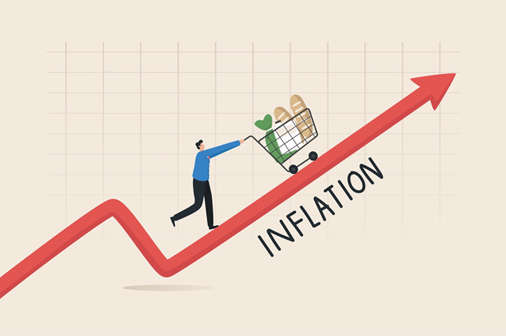
This episode is one of history’s most spectacular examples of inflation, an increase in the overall level of prices in the economy. What causes inflation? In almost all cases of large or persistent inflation, the culprit is growth in the quantity of money. When a government creates large quantities of the nation’s money, the value of the money falls. In Germany in the early 1920s, when prices were on average tripling every month, the quantity of money was also tripling every month. Although less dramatic, the economic history of the United States points to a similar conclusion: The high inflation of the 1970s was associated with rapid growth in the quantity of money, and the return of low inflation in the 1980s was associated with slower growth in the quantity of money.
Principle 10: Society Faces a Short-Run Trade-off between Inflation and Unemployment
-
Although a higher level of prices is, in the long run, the primary
effect of increasing the quantity of money, the short-run story is
more complex and controversial. Most economists describe the short-run
effects of monetary injections as follows:
- - Increasing the amount of money in the economy stimulates the overall level of spending and thus the demand for goods and services.
- - Higher demand may over time cause firms to raise their prices, but in the meantime, it also encourages them to hire more workers and produce a larger quantity of goods and services.
- - More hiring means lower unemployment.